Here at SuperMemo World, we sometimes use the expression “intelligent repetitions” or “optimised repeats”, although, in fact, deep down, we simply think “the SuperMemo method”, because it’s thanks to the publications by SuperMemo, and about SuperMemo, that the concept has taken off internationally. It all started in 1990 and 1994, when the combination of the words spaced (pl. rozstawiony, rozłożony) and repetition (pl. powtórka), which had earlier been rarely used in the world of science, appeared in publications by Dr. Piotr Woźniak (who invented and developed spaced repetition) taking on the newer, richer meaning which we ascribe to it today. Anyway, we’ll return to history later. What exactly is spaced repetition, or optimised, or active repetition?How does the spaced repetition system (method) work?
Spaced repetition aims to retain learned information while making sensible use of review time. Mathematically, this is an optimization problem: memory performance varies between people and difficulty varies between items, so one fixed interval cannot suit everything. For exam preparation, begin by organizing small, clear question-and-answer cards in Deckumi, check your understanding through active recall and return to the material deliberately.
The most important principles are:
- Rule nr 1: With each effective repetition the individual forgetting curve for a piece of information becomes flatter.
- Rule nr 2: With each effective repetition a piece of information becomes more stable in the memory.
- Rule nr 3: The more stable the information, the longer the gap to the next repetition can be.
- Rule nr 4: Forgetting information during a repetition means that the learning and stabilising process begins anew.
- Rule nr 5: The longer the gap between successful repetitions of a piece of information, the more stable in memory it becomes.
We then add to this, 3 rules mentioned in the article on the forgetting curve, namely:
- the more difficult the information, the steeper its forgetting curve is,
- the longer the gap to the next repetition, the smaller the chance of being effectively recalled,
- the 2 most important parameters defining the condition of a piece of information in the memory are retrievability and stability
and we get the “miracle” recipe for spaced repetition.
So far, the best, and most often cited illustration of spaced repetition appeared in an article on Piotr Woźniak and SuperMemo, which in 2008 appeared in the magazine Wired. So, we shall use it here.
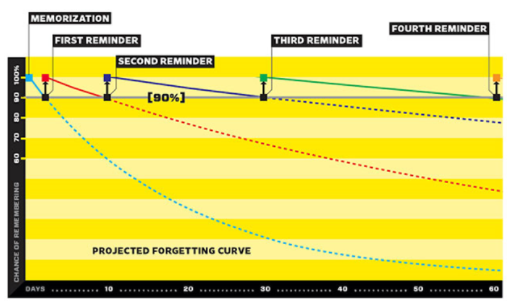
How SuperMemo works. Source: Wired
The illustration shows how successive reviews can make an item’s forgetting curve flatter, allowing later reviews to be spaced further apart. When applying this idea to study in Deckumi, focus on understanding first, recalling actively and continuing to check the material against your actual performance.
When using the open-source FSRS spaced repetition algorithm, consider both desired retention and review time. With a target retention of 90%, for example, a scheduler can assign a review when the predicted chance of recall falls to 90%. If reviews occur as scheduled and predictions are accurate, about 90 of 100 due items would be expected to be recalled. Due items are generally harder to retrieve than items that are not yet due, so retention among due items and retention across all material are different measures. Adjusting desired retention lets you trade off review frequency, study time, and recall; fewer reviews do not imply the same retention.
What the graph from Wired doesn’t show is the extremely interesting effect of rules 4 and 5. They regulate the delicate balance of the choice, “to repeat, or not to repeat”.
Rule 4 states that every time you forget, the learning process has to begin again from zero, so, in order to be able to permanently remember that thing, you must return to shorter intervals between repetitions and gradually increase them through further revisions. Of course, this is an oversimplification. Information that we have forgotten, even once, is not the same as information that we have never encountered before — just as two completely new pieces of information are not equally as easy or difficult to memorise, as they fit differently into the knowledge which we already possess. In accordance with the 2-part model of memory developed by Dr. Woźniak and his collaborators, forgotten information is that whose retrievability level has fallen beneath that at which it can be recalled. But information may include more or less stable traces. You may not recall the phone number of a friend which you dialled manually hundreds of times when calling many years ago. You might also not recall that new character in Mandarin which you only learnt yesterday, and with which you have no associations. These two pieces of information, although both forgotten, will have highly different stability levels. The stability, or the permanence of the memory trace, of your friend’s telephone number will be many times greater than that of the Mandarin character. The current stability level of a memory, as well as its degree of complexity, affects the speed with which we can return to remembering it once more. For your friend’s telephone number, you may only need to refresh your memory once to then remember it again for years. The character may require a laborious process of slowly increasing the intervals between revisions and, sadly, may be forgotten more than once.
Perhaps the most interesting and surprising rule has been left for us to discuss at the end. This is rule no 5, which entails that setting the optimal moments for revising material is like gambling in a casino, while constantly betting the house. The longer you play, the more you stand to gain, except that if you don’t quit in time, you stand to lose everything.
Our rule 5 states that the longer the gap you leave between repetitions, the stronger will be the effect on the memory trace’s durability. This is shown in the graph below, developed as a result of research carried out by SuperMemo. Repeating material immediately after learning or revising it, and so when the chances of retrieving it are 100%, has no effect on stabilising that information in memory. In such a case, the factor of the new stability level is close to 1, and so the stability of the memory trace hasn’t increased at all. On the other hand, a successful repetition performed at the moment when retrievability is at the level of 90% leads to an increase in stability of about one half (the growth factor is about 1.5). If we manage to recall information whose retrievability is close to zero, then we increase its stability almost 10-fold, which translates directly to a 10-fold increase in the interval recommended before the next repetition.
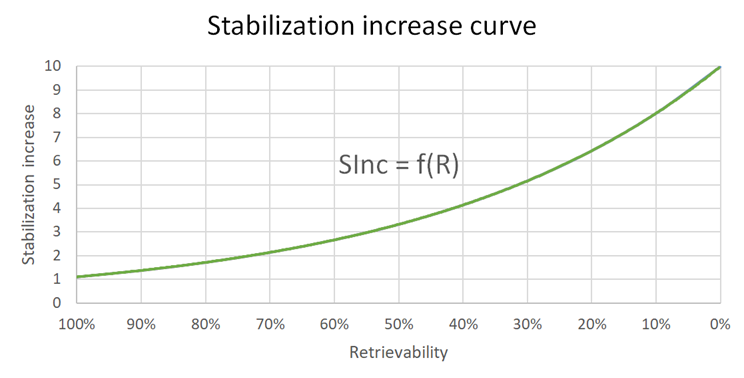
Stabilisation increase curve for a memory trace as a function of its retrievability. Source: SuperMemo research
So, if that’s the case, the longer the gap before we repeat it, the better! It pays to stretch the interval between repetitions to the maximum and eureka! True, but beware — only if you can retrieve the information. If, while repeating the material it turns out that you’ve forgotten it, your investment in learning it has been wasted, and you’ll have to start the process of learning it again, almost from scratch.
To put the study advice into practice, use Deckumi to create flashcards and break important knowledge into questions you can recall. Answer first, then reveal the answer and rate your recall. Computing review dates automatically is a separate scheduling task; explore FSRS if you need to study that capability. The algorithm discussion does not mean that Deckumi currently predicts forgetting times or maintains an automatic due queue.